Tag: Vintage Motorcycles

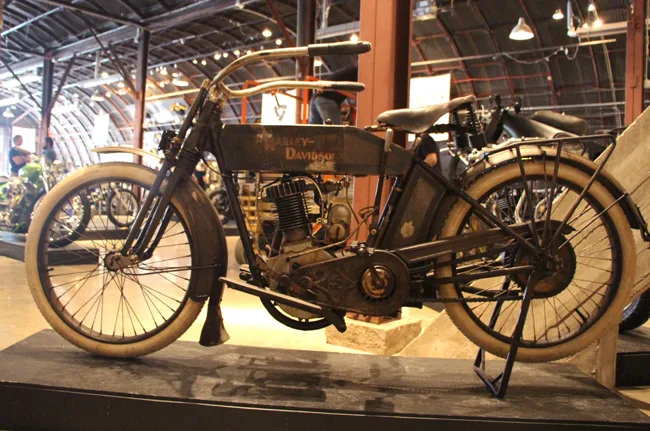
  • 1913 Antique Harley-Davidson Model 9B

    1913 Antique Harley-Davidson Model 9B

    This is an antique Harley-Davidson Model 9B that we saw at the Handbuilt Motorcycle Show. It has a 35 ci single-cylinder IOE engine. The “B” indicates a chain-drive (the Model 9A has a belt-drive). This Harley model originally sold for $235.

    Please let us know what you think of this article by posting this blog’s URL on your Facebook page with your comment. Finally, check out our Major Motorcycle Rallies and Motorcycle Events Calendar.

    Go to Our Blog Home Page
  • “Dead Pan” 1951 Panhead Chopper

    “Dead Pan” 1951 Panhead Chopper

    First, the 2017 Handbuilt Show in Austin did not disappoint again. In part because there was a wide variety of early-era to modern motorcycles.

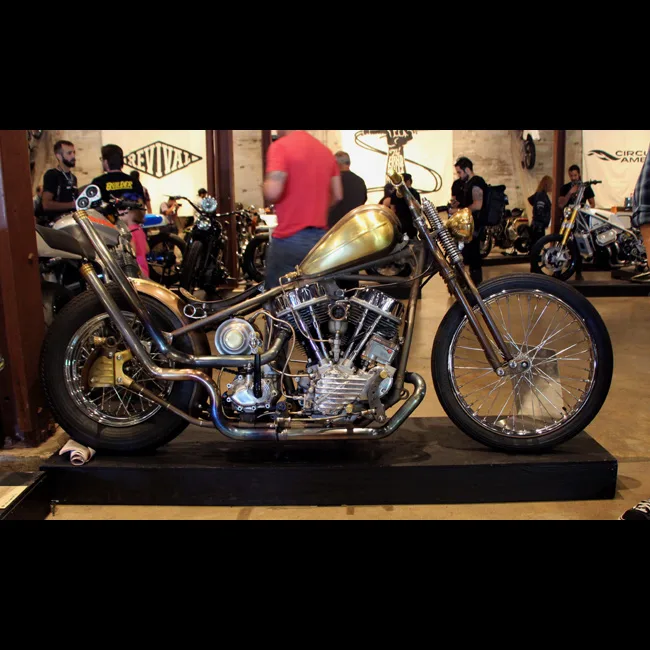
    And one of the impressive bikes was the custom “Dead Pan.” This chopper was built from a 1951 Panhead by The Forge in Loveland, Colorado. And Josh (fabricator) and Mike (owner) are the two builders.

    Then, to get more details, we got in touch with the shop. Some of the details on the Dead Pan include a 21-inch front rim, a 16-inch rear rim, a rear drum brake, no front brake, and a slap-shift foot clutch. And this makes for a good start on a classic-looking chopper. But this isn’t “just another” chopper. A lot of thought went into building the bike. And of course, it took a lot of skill to design and fabricate so many one-off parts.


    And the first part of the build was the Springer front end. This was something that Josh had envisioned for a long time. Then the brass added to the front end served as a starting point for part of the bike’s overall look. Next, the Harley FL motor and 4-speed tranny were rebuilt by Carl’s Cycle Supply. As you can see, the motor, tranny, and frame all match.

    In addition, the majority of the Panhead Chopper was handmade: gas tank, rear fender, seat, oil tank, bars, foot pegs, controls, rear brass cover plates, kicker pedal, and high chopper exhaust were all built by Josh. Other details include a Panic Cycles headlight, an After Hours Choppers rear taillight, and a BDL belt-drive system. Although the hidden gas cap came about by accident, Josh went with it, and it looks good.

    Then Josh used a hand-copper-plating technique. And as you can see, all of the work really paid off.

    Please let us know what you think of this article by pasting this blog post’s URL on your Facebook page with your comment. Finally, check out our Major Motorcycle Rallies and Motorcycle Events Calendar.

    Go to Our Blog Home Page


  • 1929 Excelsior-Henderson KJ Streamliner

    1929 Excelsior-Henderson KJ Streamliner

    First, several years ago, we were at the Handbuilt Show in Austin, Texas. One of the coolest motorcycles we saw was a 1929 Excelsior-Henderson KJ Streamliner.

    Next, here’s some background on the Excelsior-Henderson company. In 1911, William and Tom Henderson founded the Henderson Motorcycle Company. In 1911, they released their prototype.

    Then, in 1912, the Company introduced a 57 cubic inch inline four-cylinder with 7 horsepower. Over the years, there were many improvements made, races won, and records broken.

    In 1917, the brothers sold the Henderson Motorcycle Company to Ignaz Schwinn. He owned both Schwinn bicycles and Excelsior motorcycles.

    So, where did the Henderson brothers go? Well, up until 1920, they worked for Henderson-Excelsior Motorcycles. In 1920, they founded a new company, Ace Motorcycle Company.

    In 1929, the Excelsior-Henderson Streamliner was introduced. It was often referred to as the KJ. Next, this new model motorcycle had over 50 new features and upgrades. Also, it could go 100 mph. The KJ model was made in 1931. Unfortunately, as with many motorcycle companies and other companies, it did not survive the Great Depression.

    Please let us know what you think of this article by pasting this blog post’s URL on your Facebook page with your comment. Finally, check out our Major Motorcycle Rallies and Motorcycle Events Calendar.

    Go to Our Blog Home Page
  • 1904 ER Thomas Auto-Bi Motorcycle

    1904 ER Thomas Auto-Bi Motorcycle

    In 1898, Edwin Ross “E.R.” Thomas began designing his two-wheeled, internal-combustion-powered bicycle, the “Auto-Bi.” What inspired his motorized bicycle/motorcycle was the advent of the safety bicycle (a bicycle with both wheels being the same size) in 1896 and his experience manufacturing the De Dion-Bouton tricycles since 1898.

    In 1900, his company, the Thomas Motor Company out of Buffalo, New York, produced the first Auto-Bi. In 1901, the first two models for the public were available for sale. His Auto-Bicycle is referred to by some as the “first production powered two-wheeled motorcycle”.

    Pictures from the Handbuilt Motorcycle Show


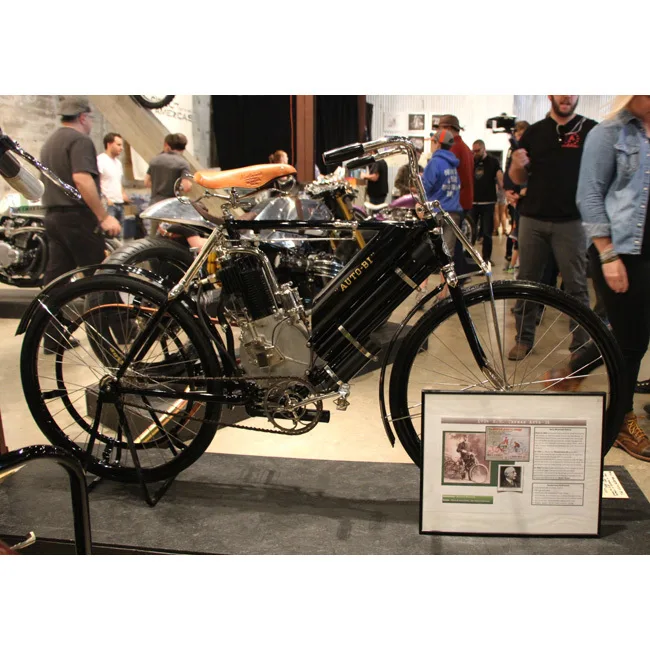
    The pictured Thomas Auto-Bi is a 1904 model. This motorized bicycle/motorcycle had a 4-stroke, 442 cubic inch engine that produced 2.5 horsepower, giving the Auto-Bicycle a 35-mph top speed. A 1905 model that was similar to the pictured Auto-Bi broke the transcontinental record by traveling across the US in 48 days.

    In 1912, there was insufficient demand for motorcycles, and the company ceased operations. E.R. Thomas moved on to building larger engines in an attempt to build an automobile company.

    Please let us know what you think of this article by posting this blog’s URL on your Facebook page with your comment. Finally, check out our Major Motorcycle Rallies and Motorcycle Events Calendar.
    Go to Our Blog Home Page
  • Motorcycle Chariot Racing

    Motorcycle Chariot Racing

    Have you ever come across vintage photos or footage of motorcycle chariot racing? It looks absolutely wild — and honestly, like a whole lot of fun.

    Unfortunately, there isn’t much detailed information about the history of motorcycle chariot racing. Still, here’s a brief look at the origins of this outrageous style of competition.

    The inspiration for this unique form of racing is often traced back to the 1925 film Ben-Hur: A Tale of the Christ. The dramatic chariot scenes captured imaginations, and before long, enthusiasts began recreating the spectacle with motorcycles. The earliest motorcycle chariots and organized races appear to have started in Australia, with the United States and parts of Europe soon following suit.

    So, what led to the downfall of motorcycle chariot racing? A major factor was the Great Depression. During that time, many people were simply trying to make ends meet. Few could justify the cost of building and maintaining a chariot pulled by two motorcycles — especially when crashes and mechanical damage were almost guaranteed.

    Then came World War II, which delivered the final blow. Wartime rationing severely limited access to metals and other essential materials.

    As a result, many motorcycle manufacturers struggled or shut down entirely, particularly those that did not secure government contracts and therefore lacked access to the resources needed to survive.

    Please let us know what you think of this article by pasting this post’s URL on your Facebook page with your comment. Finally, you might want to check out our Major Motorcycle Rallies and Motorcycle Events Calendar.

    Go to Our Blog Home Page

  • Harley-Davidson “Peashooter” Motorcycle

    Harley-Davidson “Peashooter” Motorcycle

    Here’s some history of the one-lung Harley-Davidson “Peashooter” motorcycle. To start, in 1925, the AMA introduced a 21-cubic-inch (350cc) racing class.

    And Indian and Excelsior already had 21-cubic-inch motorcycles, but Harley did not. HD’s focus was on their big-twin engines. But there was also a larger, less profitable market for smaller motorcycles. And this was definitely the case in Europe, Australia, and South Africa.


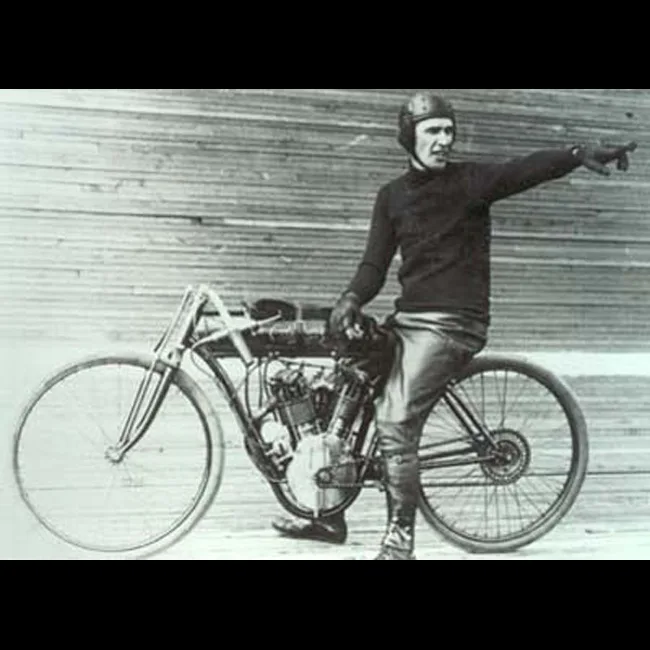
    Next, the AMA created the 21-inch class in the hope that lower speeds would be safer for riders. But what was to become known as the “Peashooter” was fast. It could run on the track at 100mph. In addition, this new class was created to lower racers’ expenses.

    Back in the day, motorcycle racing and especially winning, was a great way to market motorcycles. Subsequently, Harley started working on creating a new 21 cubic-inch model.

    In a short time, they introduced a 1926 model with a 21 cubic-inch engine. These had single-cylinder side-valve engines. The two road bike models were the A and B.

    Then there was also a factory-built production racing version model – the SA. And it had OHV and some other engine upgrades. Also, there were other modifications to make these small Harleys lighter. So, it was fast.

    Due to the popping sound of the racing version engine, it was dubbed the “Peashooter.” And this name caught on for both the street and racing models.

    Please let us know what you think of this article by pasting this post’s URL on your Facebook page with your comment. Finally, you might want to check out our Major Motorcycle Rallies and Motorcycle Events Calendar.

    Go to Our Blog Home Page
  • Old Harley Chopper vs Honda CBR 1000RR

    Old Harley Chopper vs Honda CBR 1000RR

    Here’s a video of an old Harley chopper racing a Honda CBR1000RR. And Hildo, the owner of the chopper, beats a 170hp+ Honda CBR1000RR Fireblade.

    Please let us know what you think of this article by pasting this post’s URL on your Facebook page with your comment. Finally, you might want to check out our Major Motorcycle Rallies and Motorcycle Events Calendar.

    Go to Our Blog Home Page

  • Who Were Harley’s Founders?

    Who Were Harley’s Founders?

    Of course, you know Harley-Davidson, the company. But do you know who all the founders of Harley were and when they joined the company? 

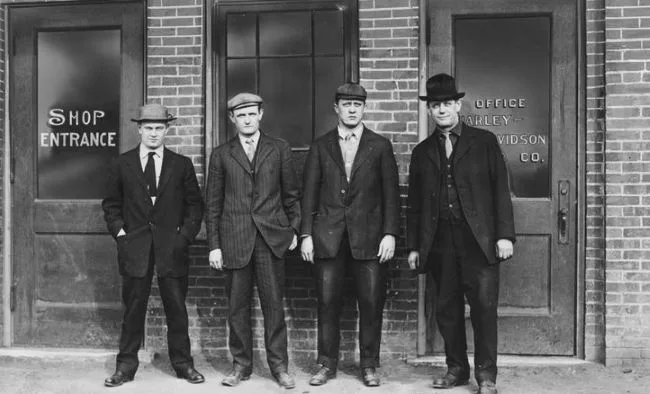
    Harley Davidson Founders HD’s Founders from Left to Right: William Davidson, Walter Davidson, Arthur Davidson, and William Harley

    In 1901, William Harley drew up designs for a 7.07 cu in (116 cc) small engine when he was only 20 years old. The engine was designed to fit in a bicycle frame.

    He worked with his childhood friend, Arthur Davidson, on their motorized bicycle. Then, in 1903, Walter Davidson helped the two finish their motor-bicycle.

    Unfortunately, the motorized bicycle’s engine did not have enough power to climb hills in Milwaukee without pedaling. Their first motorcycle was not a total failure, but more of a learning experience.

    Next, the three started working on a 24.74 cu in (405 cc). It used a loop-frame design with a larger engine. And it was assembled in a shed in the Davidson backyard. This brought it from the realm of being a motor-bicycle to a motorcycle.

    Then, with the help of William Davidson, the motorcycle was finished in September of 1904.

    This design was a lot faster; it took fourth place in the Milwaukee State Fair race. In 1906, the Chestnut Street (later Juneau Avenue) was built as the first Harley-Davidson factory. And from there, four young men started the legendary brand.

    Please let us know what you think of this article by pasting this post’s URL on your Facebook page with your comment. Finally, you might want to check out our Major Motorcycle Rallies and Motorcycle Events Calendar.

    Go to Our Blog Home Page


  • 1930s Vintage Motorcycle Hillclimb

    1930s Vintage Motorcycle Hillclimb

    This vintage 16mm home movie shows an old, 1930s motorcycle hillclimb in California.

    Please let us know what you think of this article by pasting this blog post’s URL on your Facebook page with your comment. Finally, check out our Major Motorcycle Rallies and Motorcycle Events Calendar.

    Go to Our Blog Home Page

  • Cyclone Motorcycle – History & Pictures

    Cyclone Motorcycle – History & Pictures

    The Cyclone Motor Manufacturing Company manufactured the Cyclone Motorcycle. Andrew Strand designed the Cyclone. He was of Swedish descent and had worked in the American automobile industry. The motorcycles were manufactured by the Joerns Motor Manufacturing Company in St. Paul, MN, from 1912 to 1917.

     
    With many improvements over motorcycles of its day and high performance, the Cyclone motorcycles were competitive in both board-track and dirt-track races. The motorcycles had a 61 cu in / 1,000 cc V-twin with overhead cams, shaft drive, and other impressive features that gave it high performance with 45 hp.

    How fast was it? In 1914, it broke Excelsior’s record by reaching 111 mph. The Cyclone bikes were estimated to have a top end of 115 mph.

    With only 13 Cyclones left, the price tag for one of these is high. In 2015, a Cyclone owned by Steve McQueen was sold at auction for $852,000.

    The company closed after finding that the Cyclones could not compete in the marketplace with lower-cost competitors’ motorcycles.

    Please let us know what you think of this article by posting this blog’s URL on your Facebook page with your comment. Finally, check out our Major Motorcycle Rallies and Motorcycle Events Calendar.

    Go to Our Blog Home Page