Tag: Old Motorcycles

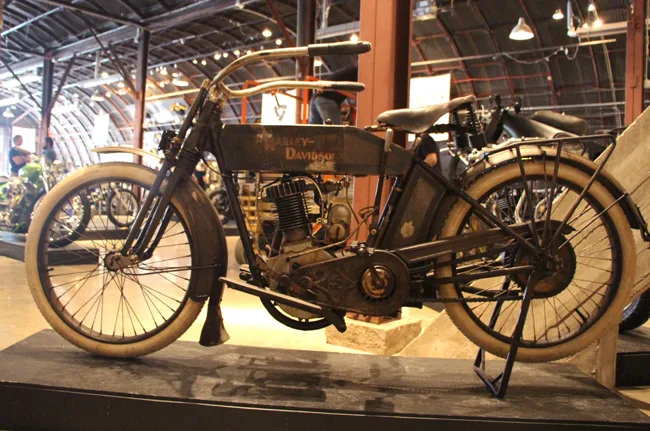
  • 1913 Antique Harley-Davidson Model 9B

    1913 Antique Harley-Davidson Model 9B

    This is an antique Harley-Davidson Model 9B that we saw at the Handbuilt Motorcycle Show. It has a 35 ci single-cylinder IOE engine. The “B” indicates a chain-drive (the Model 9A has a belt-drive). This Harley model originally sold for $235.

    Please let us know what you think of this article by posting this blog’s URL on your Facebook page with your comment. Finally, check out our Major Motorcycle Rallies and Motorcycle Events Calendar.

    Go to Our Blog Home Page
  • “Dead Pan” 1951 Panhead Chopper

    “Dead Pan” 1951 Panhead Chopper

    First, the 2017 Handbuilt Show in Austin did not disappoint again. In part because there was a wide variety of early-era to modern motorcycles.

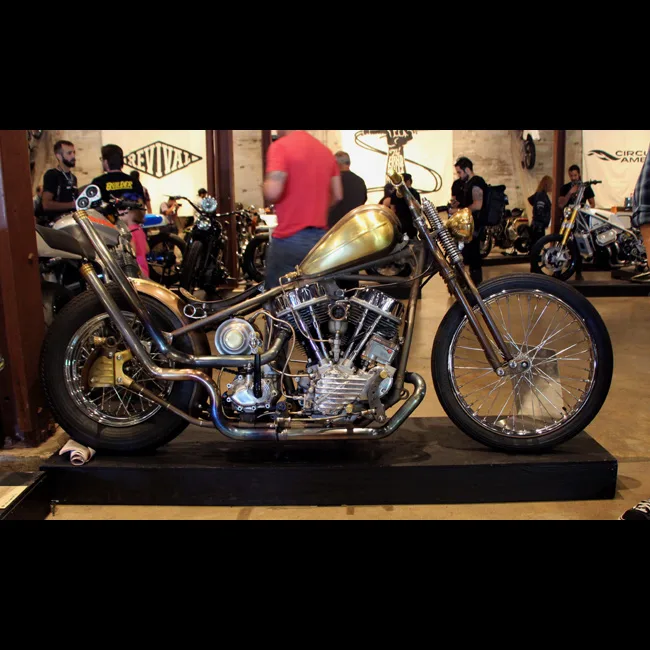
    And one of the impressive bikes was the custom “Dead Pan.” This chopper was built from a 1951 Panhead by The Forge in Loveland, Colorado. And Josh (fabricator) and Mike (owner) are the two builders.

    Then, to get more details, we got in touch with the shop. Some of the details on the Dead Pan include a 21-inch front rim, a 16-inch rear rim, a rear drum brake, no front brake, and a slap-shift foot clutch. And this makes for a good start on a classic-looking chopper. But this isn’t “just another” chopper. A lot of thought went into building the bike. And of course, it took a lot of skill to design and fabricate so many one-off parts.


    And the first part of the build was the Springer front end. This was something that Josh had envisioned for a long time. Then the brass added to the front end served as a starting point for part of the bike’s overall look. Next, the Harley FL motor and 4-speed tranny were rebuilt by Carl’s Cycle Supply. As you can see, the motor, tranny, and frame all match.

    In addition, the majority of the Panhead Chopper was handmade: gas tank, rear fender, seat, oil tank, bars, foot pegs, controls, rear brass cover plates, kicker pedal, and high chopper exhaust were all built by Josh. Other details include a Panic Cycles headlight, an After Hours Choppers rear taillight, and a BDL belt-drive system. Although the hidden gas cap came about by accident, Josh went with it, and it looks good.

    Then Josh used a hand-copper-plating technique. And as you can see, all of the work really paid off.

    Please let us know what you think of this article by pasting this blog post’s URL on your Facebook page with your comment. Finally, check out our Major Motorcycle Rallies and Motorcycle Events Calendar.

    Go to Our Blog Home Page


  • 1929 Excelsior-Henderson KJ Streamliner

    1929 Excelsior-Henderson KJ Streamliner

    First, several years ago, we were at the Handbuilt Show in Austin, Texas. One of the coolest motorcycles we saw was a 1929 Excelsior-Henderson KJ Streamliner.

    Next, here’s some background on the Excelsior-Henderson company. In 1911, William and Tom Henderson founded the Henderson Motorcycle Company. In 1911, they released their prototype.

    Then, in 1912, the Company introduced a 57 cubic inch inline four-cylinder with 7 horsepower. Over the years, there were many improvements made, races won, and records broken.

    In 1917, the brothers sold the Henderson Motorcycle Company to Ignaz Schwinn. He owned both Schwinn bicycles and Excelsior motorcycles.

    So, where did the Henderson brothers go? Well, up until 1920, they worked for Henderson-Excelsior Motorcycles. In 1920, they founded a new company, Ace Motorcycle Company.

    In 1929, the Excelsior-Henderson Streamliner was introduced. It was often referred to as the KJ. Next, this new model motorcycle had over 50 new features and upgrades. Also, it could go 100 mph. The KJ model was made in 1931. Unfortunately, as with many motorcycle companies and other companies, it did not survive the Great Depression.

    Please let us know what you think of this article by pasting this blog post’s URL on your Facebook page with your comment. Finally, check out our Major Motorcycle Rallies and Motorcycle Events Calendar.

    Go to Our Blog Home Page
  • 1904 ER Thomas Auto-Bi Motorcycle

    1904 ER Thomas Auto-Bi Motorcycle

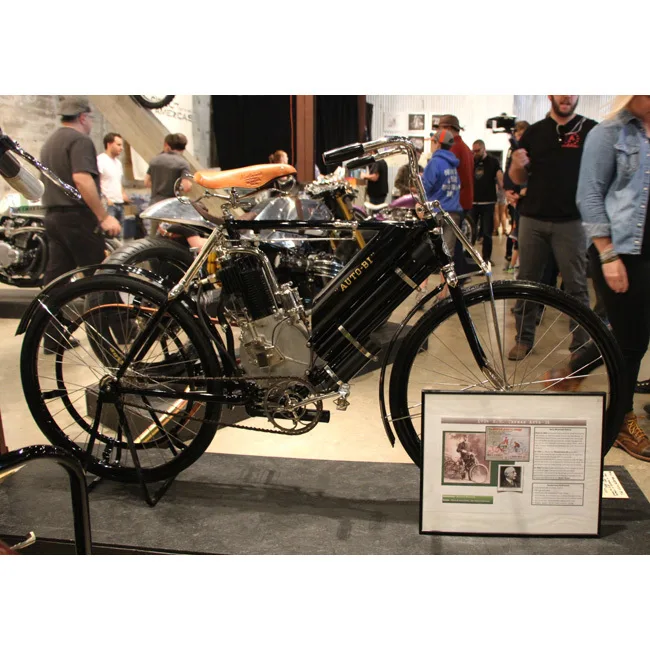
    In 1898, Edwin Ross “E.R.” Thomas began designing his two-wheeled, internal-combustion-powered bicycle, the “Auto-Bi.” What inspired his motorized bicycle/motorcycle was the advent of the safety bicycle (a bicycle with both wheels being the same size) in 1896 and his experience manufacturing the De Dion-Bouton tricycles since 1898.

    In 1900, his company, the Thomas Motor Company out of Buffalo, New York, produced the first Auto-Bi. In 1901, the first two models for the public were available for sale. His Auto-Bicycle is referred to by some as the “first production powered two-wheeled motorcycle”.

    Pictures from the Handbuilt Motorcycle Show


    The pictured Thomas Auto-Bi is a 1904 model. This motorized bicycle/motorcycle had a 4-stroke, 442 cubic inch engine that produced 2.5 horsepower, giving the Auto-Bicycle a 35-mph top speed. A 1905 model that was similar to the pictured Auto-Bi broke the transcontinental record by traveling across the US in 48 days.

    In 1912, there was insufficient demand for motorcycles, and the company ceased operations. E.R. Thomas moved on to building larger engines in an attempt to build an automobile company.

    Please let us know what you think of this article by posting this blog’s URL on your Facebook page with your comment. Finally, check out our Major Motorcycle Rallies and Motorcycle Events Calendar.
    Go to Our Blog Home Page
  • Motorcycle Chariot Racing

    Motorcycle Chariot Racing

    Have you ever come across vintage photos or footage of motorcycle chariot racing? It looks absolutely wild — and honestly, like a whole lot of fun.

    Unfortunately, there isn’t much detailed information about the history of motorcycle chariot racing. Still, here’s a brief look at the origins of this outrageous style of competition.

    The inspiration for this unique form of racing is often traced back to the 1925 film Ben-Hur: A Tale of the Christ. The dramatic chariot scenes captured imaginations, and before long, enthusiasts began recreating the spectacle with motorcycles. The earliest motorcycle chariots and organized races appear to have started in Australia, with the United States and parts of Europe soon following suit.

    So, what led to the downfall of motorcycle chariot racing? A major factor was the Great Depression. During that time, many people were simply trying to make ends meet. Few could justify the cost of building and maintaining a chariot pulled by two motorcycles — especially when crashes and mechanical damage were almost guaranteed.

    Then came World War II, which delivered the final blow. Wartime rationing severely limited access to metals and other essential materials.

    As a result, many motorcycle manufacturers struggled or shut down entirely, particularly those that did not secure government contracts and therefore lacked access to the resources needed to survive.

    Please let us know what you think of this article by pasting this post’s URL on your Facebook page with your comment. Finally, you might want to check out our Major Motorcycle Rallies and Motorcycle Events Calendar.

    Go to Our Blog Home Page

  • What Was the First Motorcycle Made?

    What Was the First Motorcycle Made?

    What was the very first motorcycle ever built? It’s a question that comes up often in the motorcycle world — and depending on who you ask, the answer can be very different.

    A big part of the disagreement comes down to definition. What exactly qualifies as a motorcycle?
    • Most people agree it must have some propulsion system — but what kind? Does it have to be powered by an internal combustion engine, or do steam engines and electric motors count?
    • Must it have only two wheels?
    • If it has small outrigger wheels that don’t touch the ground while riding, does this disqualify it?
    • And are we talking about the first motorcycle in the world, or just the first built in the United States?

    Fifteen or more years ago, the debate centered largely on engine type. Many enthusiasts insisted a “real” motorcycle had to use an internal combustion engine. Others were satisfied with steam power.

    Today, with the rise of electric motorcycles — regardless of where you stand on them — the conversation has evolved yet again, reshaping how some people view the earliest machines.

    Three of the Most Recognized “First” Motorcycles

      
    Pierre Michaux Velocipede
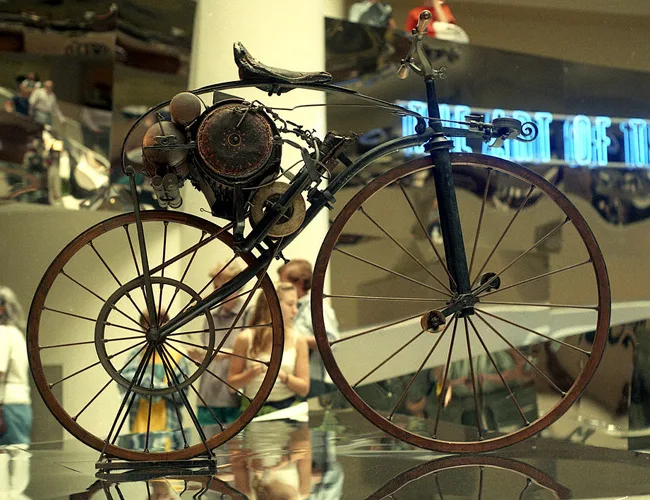
    In the 1860s, Pierre Michaux built pedal bicycles known as velocipedes in France. In 1867, his son Ernest mounted a small steam engine onto one of these machines. For some historians, this antique steam-powered velocipede qualifies as the first motorcycle.

    Michaux-Perreaux Steam Velocipede

     
    Sylvester Roper Steam Velocipede
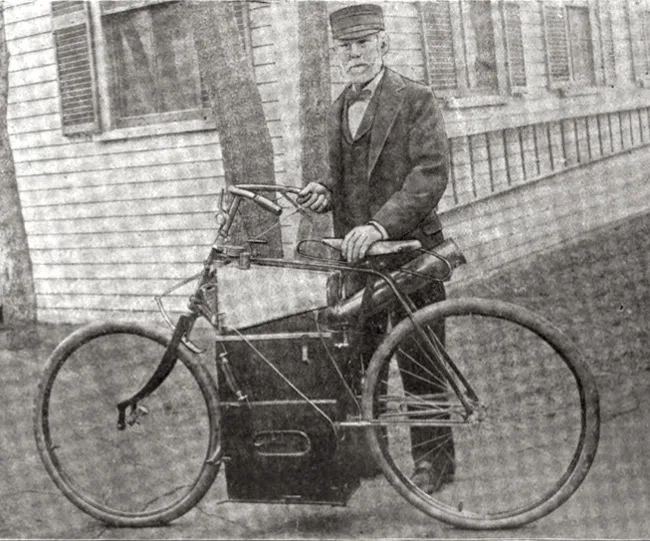
    In 1868, Sylvester Roper of Massachusetts designed a steam-powered velocipede featuring a twin-cylinder engine. He continued developing and demonstrating his machines until 1896, when he tragically died while riding one. Many consider Roper’s creation the first motorcycle built in the United States.
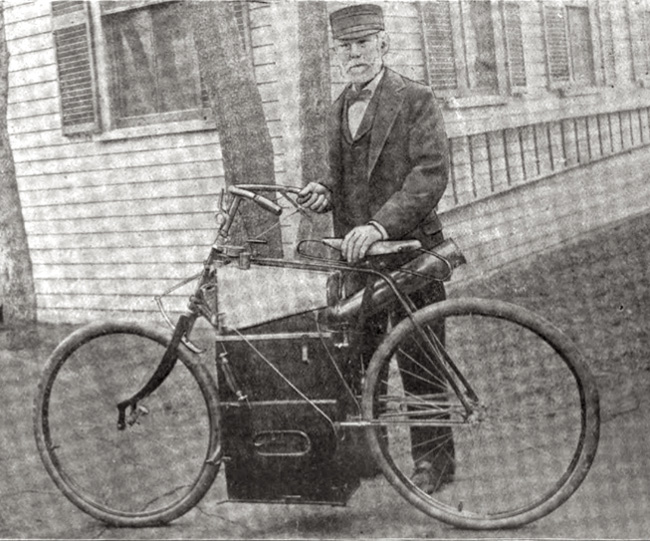
    Aged Picture of Sylvester Roper with His Roper Motorcycle

     
    Daimler Reitwagen
    Developed in 1885 in Germany by Gottlieb Daimler and Wilhelm Maybach, the Reitwagen used an internal combustion engine — a key point for those who insist that “true” motorcycles must run on gasoline.

    The machine had two large primary wheels and two small outrigger wheels. Because of this, some argue it was technically a four-wheeled vehicle. However, since it could operate without the outriggers, many historians recognize it as a strong contender for the first true motorcycle.

    Vintage Picture of a Daimler Reitwagen


    Other Important Early Motorcycles

    Below are some other notable motorcycles.

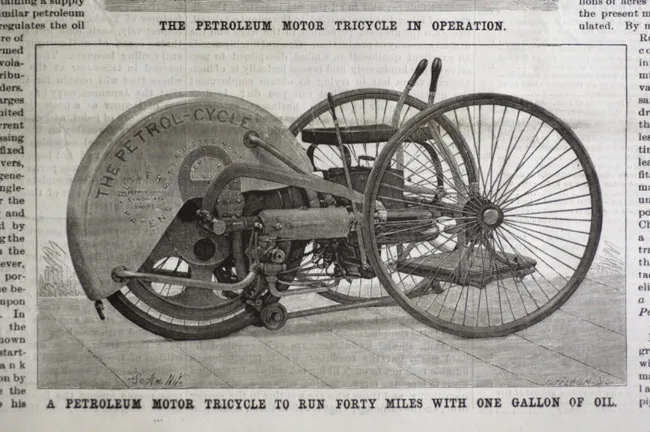
    Butler Petrol Cycle
    Introduced in England in 1884 by Edward Butler, the Butler Petrol Cycle had three wheels — making it technically a tricycle rather than a motorcycle. Still, it was notable for its petroleum-powered engine and innovative design, setting it apart from traditional four-wheeled vehicles of the time.
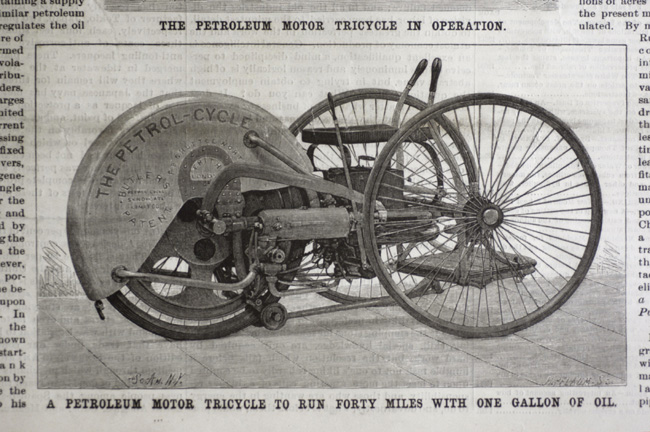
    Butler Petrol Cycle Motorcycle
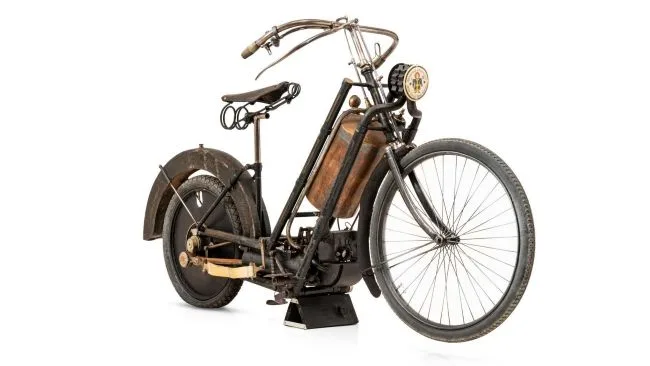
    Hildebrand & Wolfmüller
    Built in Germany in 1894, this machine is significant because it was the first production vehicle officially called a “motorcycle.” It had two wheels and an internal combustion engine — features most people associate with modern motorcycles.

    The design differed from today’s bikes: the engine placement was unconventional, the frame lacked a backbone, and it resembled a 1970s moped. Unlike the Michaux and Roper machines, it also had no pedals.
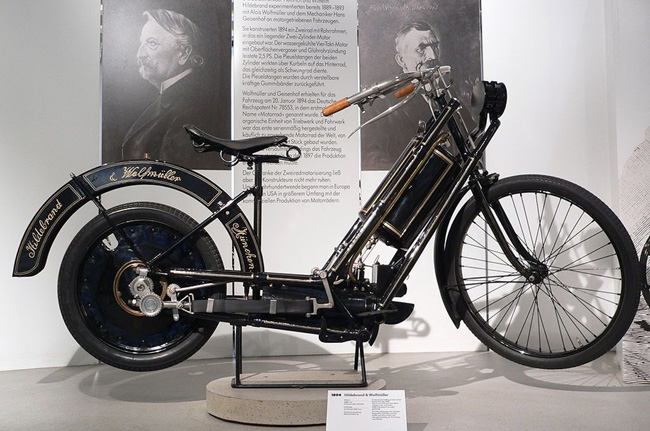
    1894 Hildebrand Wolfmuller Motorcycle
    Black Hildebrand Wolfmuller Motorcycle
     
    Orient-Aster Motorcycles
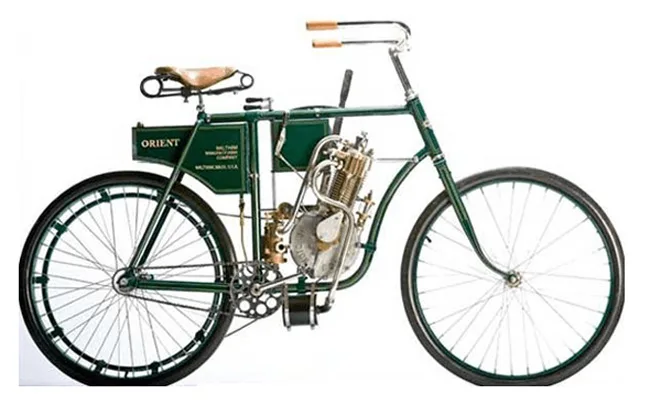
    In 1898, Charles Metz began producing Orient-Aster motorcycles in Massachusetts. Though the company eventually went out of business, these are widely recognized as the first production motorcycles made in the United States.

    Orient Aster Motorcycle


    Peugeot Motorcycles
    In 1898, Peugeot also produced its first motorcycle. While the company now focuses primarily on scooters, some historians consider Peugeot the oldest surviving motorcycle manufacturer in the world.
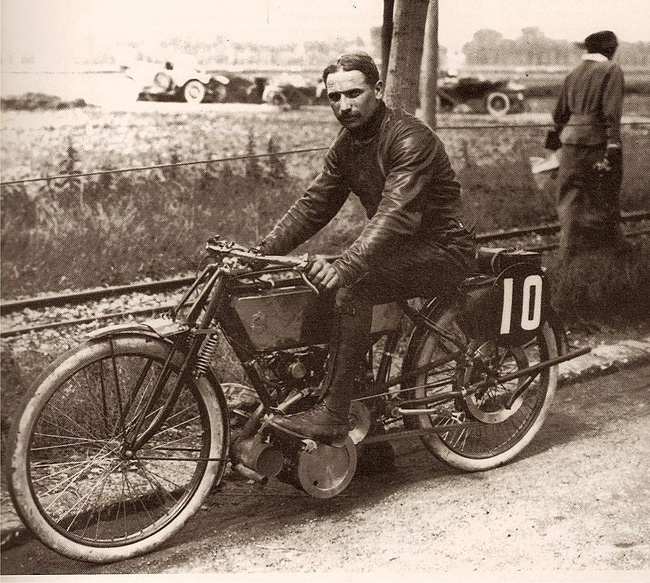
     

    Peugeot Motorcycle Vintage Black and White Picture

     
    With all of the above being noted, the “first motorcycle” depends on how you define a motorcycle. Some people and historians prioritize gas engines, steam-powered engines, models that went into production, or the geographic location where each motorcycle was made. Each of these machines has a legitimate claim. The answer to the question of who made the first motorcycle isn’t easy — but that is one reason why motorcycle history is interesting.

    Please let us know what you think of this article by pasting this post’s URL on your Facebook page with your comment. Finally, you might want to check out our Major Motorcycle Rallies and Motorcycle Events Calendar.

    Go to Our Blog Home Page

  • Old Harley Chopper vs Honda CBR 1000RR

    Old Harley Chopper vs Honda CBR 1000RR

    Here’s a video of an old Harley chopper racing a Honda CBR1000RR. And Hildo, the owner of the chopper, beats a 170hp+ Honda CBR1000RR Fireblade.

    Please let us know what you think of this article by pasting this post’s URL on your Facebook page with your comment. Finally, you might want to check out our Major Motorcycle Rallies and Motorcycle Events Calendar.

    Go to Our Blog Home Page
  • 1930s Vintage Motorcycle Hillclimb

    1930s Vintage Motorcycle Hillclimb

    This vintage 16mm home movie shows an old, 1930s motorcycle hillclimb in California.

    Please let us know what you think of this article by pasting this blog post’s URL on your Facebook page with your comment. Finally, check out our Major Motorcycle Rallies and Motorcycle Events Calendar.

    Go to Our Blog Home Page

  • Cyclone Motorcycle – History & Pictures

    Cyclone Motorcycle – History & Pictures

    The Cyclone Motor Manufacturing Company manufactured the Cyclone Motorcycle. Andrew Strand designed the Cyclone. He was of Swedish descent and had worked in the American automobile industry. The motorcycles were manufactured by the Joerns Motor Manufacturing Company in St. Paul, MN, from 1912 to 1917.

     
    With many improvements over motorcycles of its day and high performance, the Cyclone motorcycles were competitive in both board-track and dirt-track races. The motorcycles had a 61 cu in / 1,000 cc V-twin with overhead cams, shaft drive, and other impressive features that gave it high performance with 45 hp.

    How fast was it? In 1914, it broke Excelsior’s record by reaching 111 mph. The Cyclone bikes were estimated to have a top end of 115 mph.

    With only 13 Cyclones left, the price tag for one of these is high. In 2015, a Cyclone owned by Steve McQueen was sold at auction for $852,000.

    The company closed after finding that the Cyclones could not compete in the marketplace with lower-cost competitors’ motorcycles.

    Please let us know what you think of this article by posting this blog’s URL on your Facebook page with your comment. Finally, check out our Major Motorcycle Rallies and Motorcycle Events Calendar.

    Go to Our Blog Home Page

  • The Vespa 150 TAP Scooter with a Cannon

    The Vespa 150 TAP Scooter with a Cannon

    In 1949, the Italian Vespa Company unveiled prototypes of a scooter with a bazooka cannon mounted on it. In 1952, the Vespa 150 TAP (Troupes Aéro Portées) scooters were modified for use by paratroopers. The “150” part of the model name was used because the Vespas used a 150cc engine. With this upgraded engine and lowered gearing, the Vespa’s could go 40mph.

    The Vespas were also modified by the French company, Ateliers de Construction de Motocycles et Automobiles (ACMA). This was the assembly plant for Vespas in France at the time.


    Some of the modifications made were a reinforced frame and a three-inch M20 75mm recoilless rifle mounted to the Vespa. The gun, or at this size more of a cannon or a bazooka, used a High-Explosive Anti-Tank (HEAT) warhead. The bazooka Vespas were cheap, being sold at only $500.

    The TAP Vespas were dropped with two-person parachute teams. To avoid damage to the scooters when dropped from planes, they were protected by hay bales. On one Vespa, there would be the gun; on another, a tripod. Although the preferred way to shoot the cannon was on a tripod, it could be fired directly from a moving Vespa in an emergency.
    The M20 was initially designed as an armor-piercing, anti-tank weapon using the HEAT warhead. Manufacturers said the M20s could penetrate 100mm of armor and had a range of 7,000 yds. Although this didn’t prove to be the case, it could fortify positions in war.

    In 1959, because there were many new vehicles, weapons, and ways to quickly and easily get things into battle areas, production of the Vespa 150 TAP scooter ceased.

    Please let us know what you think of this article by posting this blog’s URL on your Facebook page with your comment. Finally, check out our Major Motorcycle Rallies and Motorcycle Events Calendar.

    Go to Our Blog Home Page