Author: lightningcustoms

  • Online Marketing Statistics Every Motorcycle Business Should Know

    Online Marketing Statistics Every Motorcycle Business Should Know

    Numbers that prove (or disprove) what’s actually working in motorcycle digital marketing. From site speed to social media to shipping, here are the stats motorcycle businesses should plan around in 2026.

    Important Data to Drive Your Decisions

    If you want to survive or expand, excellence in all aspects of your online business is a must. Below are some invaluable site marketing statistics. They highlight how critical it is to deliver excellence in your online biker business. 

    Site Design Statistics

    Here are some statistics showing the importance of having a quality website design. Furthermore, these website statistics show that you must have quality content and an easy-to-use website.

    • 94% of first impressions of a company are related to its website’s design (Researchgate.net).
    • There’s an 80% increase in conversion rate if the landing pages address their fears (Hubspot.com).
    • 76% of people said the most important elements of website design is quickly finding information (Hubspot.com).
    • 75% of people online judge a website’s credibility based on its overall look (Invisionapp.com).
    • 74% of people will switch brands if the buying process is too difficult (Hubspot.com).
    • 3 to 5 seconds is the amount of time (AKA a blink test) that visitors spend when deciding whether to stay on a website (Hubspot.com).

    Search Engine Stats

    As you will read below, “pretty good” motorcycle SEO won’t get your website the rankings it needs for success. Moreover, you need an expert SEO agency to maximize your revenue.

    • 95% of search traffic goes only to the first page of search results (Digitalsynopsis.com).
    • 54.4% of all clicks are received by the top three Google search result listings (Backlinko.com).
    • The top-ten search engine listings, and of course, search results featured snippets, get 10x clicks compared to all other listings (Hubspot.com).

    Website Page Speed Stats

    Also, the website speed stats below emphasize the importance of a fast site. The faster your site, the better. It’s important to note that the developer of your motorcycle site plays a crucial role in determining its page speed.

    • 82% of consumers say slow page speeds impact purchasing decisions (Unbounce.com).
    • 73% of consumers would likely try an alternative site if the page they were on was too slow (Eggplantsoftware.com).
    • 8.9 pages are viewed by shoppers when the page load speed is 2 seconds, but that drops to only 3.3 pages when the load time is 8 seconds (Section.io).

    General Customer Service Statistic

    Excellent customer service has never been more important for online success – 90% of Americans decide whether or not to do business with a company by using customer service (Microsoft.com).

    Existing Customers Statistics

    Whether you are learning how to market your motorcycle company or are experienced, you should know how important happy existing customers are.

    • It costs to get a new customer between 5 and 25 times than to get a new customer than to retain an existing one (Invespcro.com)
    • A 5% increase in keeping customers can increase profits by 25%-95% (Invesprco.com).
    • 65% of the average company’s sales come from existing customers (Invesprco.com).
    • Existing customers will try a new motorcycle product 50% more often and spend 30% more than new customers(99firms.com).

    Positive Customer Service Stats

    As you know, online shopping has boomed over the years. And your biker business offering quality service can significantly impact your sales.

    • 94% of Americans will recommend a company whose customer service they rate as “very good” (Qualtrics.com).
    • 93% of customers will likely make repeat purchases with motorcycle companies that offer an excellent customer experience (Hubspot.com).
    • 82% of customers spend more money with motorcycle companies that offer excellent online services (Site.gladly.com).

    Negative Customer Service Statistics

    On the other hand, if your motorcycle business provides a poor customer service experience, it significantly hurts your online revenue.

    • According to Truelist.co, 71% of consumers said they ended a company relationship due to poor customer service.
    • 51% of purchasers with a negative experience will never buy from that company again (Hubspot.com).
    • 1 in 3 consumers says they’ll leave a brand, even if it is a brand they love, after just one bad experience (PWC.com).

    Customer Review Statistics

    As you probably know, reviews have always been important to your motorcycle site’s sales. And today, reviews play a significant role in your conversion rate.

    • Before purchasing a product, 93% of individuals read online reviews of a company, according to Qualtrics.com.
    • 76% of individuals place the same level of trust in online reviews in recommendations from family and friends (BrightLocal.com).
    • According to Zippia.com, 72% of customers share their website experience with six or more people.
    • 13 minutes and 45 seconds is the time an average consumer spends reading reviews before deciding (BrightLocal).
    • User-generated content (including negative reviews and comments) is 6.6 times more likely to impact than company-provided information (Nosto.com).

    General Social Media Stats

    Social media is extremely popular. Quality, regular motorcycle social is important for your business’s success.

    • 4.62 billion people across the world use social media (Hootsuite.com).
    •  The average adult spends 95 minutes each daily on social media sites (Emarketer.com).
    • 48% of people buy from responsive companies on social media (SproutSocial.com).

    Facebook Statistics

    If your biker target audience is over 30, you must have a quality, active Facebook presence. Also, Facebook advertising is a great way to interact with your biker audience, build your brand, gain awareness, and generate sales.

    • 70% plus of American adults use Facebook (Pewresearch.com).
    • Facebook is the most used social media platform, with the highest ROI, best engagement, and highest quality leads generated (Hubspot.com).
    • 34.6 minutes per day is the average amount of time US users spend on Facebook (Hootsuite.com).
    • Facebook.com is the third-most-visited website in the world behind Google and YouTube (Hootsuite.com).

    Free Shipping Statistics

    Also, free shipping is a highly effective way to close sales. People value free shipping a lot more than the actual cost of free shipping (zero-price effect).

    • 49.3% of people stated that free shipping is the most important factor when shopping online (Oberlo.com).
    • 49% of people will abandon their shopping carts because the extra costs (above the product cost) at checkout were too high (Baymard.com).

    Mobile Website Stats

    Next, having an excellent mobile version of your site is now more important than your desktop website.

    • 59% of all website traffic originates from mobile searches (Statista.com).
    • Google uses a website’s mobile version to determine how mobile and desktop sites rank (Google).

    With all of the above internet marketing statistics, you can see how you must strive for excellence in everything you do. Finally, read more informative articles on Revolution’s blog or our search & web services pages.

    Motorcycle-industry takeaways

    If you run a motorcycle business and want this applied to your site, the team at Revolution Motorcycle Marketing covers all of it: SEO, web design, content, and conversion work done only for the bike industry. Start with a free website audit and we’ll tell you exactly where to begin.
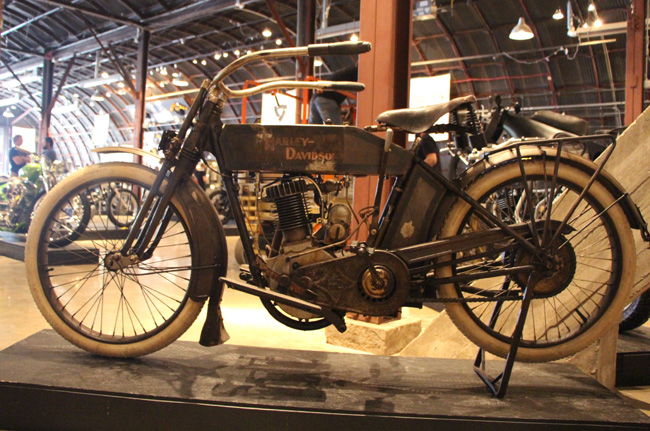
  • 1913 Antique Harley-Davidson Model 9B

    1913 Antique Harley-Davidson Model 9B

    This is an antique Harley-Davidson Model 9B that we saw at the Handbuilt Motorcycle Show. It has a 35 ci single-cylinder IOE engine. The “B” indicates a chain-drive (the Model 9A has a belt-drive). This Harley model originally sold for $235.

    Please let us know what you think of this article by posting this blog’s URL on your Facebook page with your comment. Finally, check out our Major Motorcycle Rallies and Motorcycle Events Calendar.

    Go to Our Blog Home Page


  • 1929 Excelsior-Henderson KJ Streamliner

    1929 Excelsior-Henderson KJ Streamliner

    Article & Pictures by Revolution Motorcycle Marketing

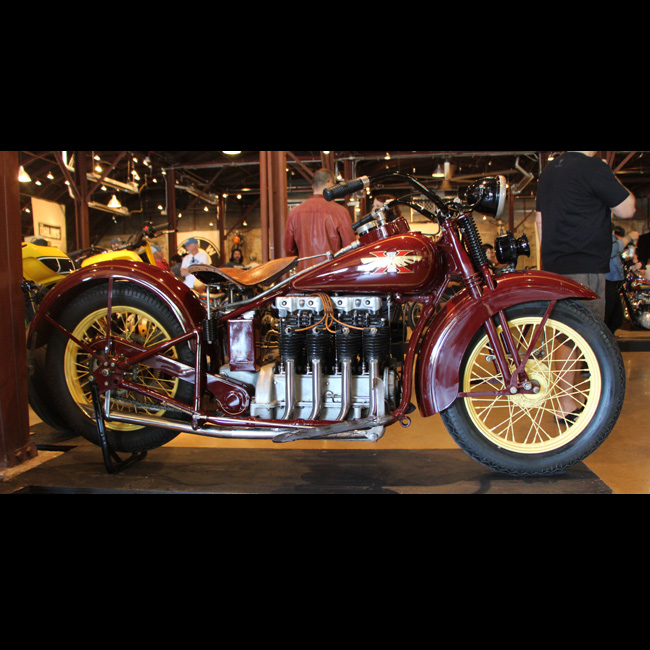
    First, several years ago, we were at the Handbuilt Show in Austin, Texas. One of the coolest motorcycles we saw was a 1929 Excelsior-Henderson KJ Streamliner.

    Next, here’s some background on the Excelsior-Henderson company. In 1911, William and Tom Henderson founded the Henderson Motorcycle Company. In 1911, they released their prototype.

    Then, in 1912, the Company introduced a 57 cubic inch inline four-cylinder with 7 horsepower. Over the years, there were many improvements made, races won, and records broken.

    In 1917, the brothers sold the Henderson Motorcycle Company to Ignaz Schwinn. He owned both Schwinn bicycles and Excelsior motorcycles.

    Photo Credit – Revolution Motorcycle Marketing

    So, where did the Henderson brothers go? Well, up until 1920, they worked for Henderson-Excelsior Motorcycles. In 1920, they founded a new company, Ace Motorcycle Company.

    In 1929, the Excelsior-Henderson Streamliner was introduced. It was often referred to as the KJ. Next, this new model motorcycle had over 50 new features and upgrades. Also, it could go 100 mph. The KJ model was made in 1931. Unfortunately, as with many motorcycle companies and other companies, it did not survive the Great Depression.

    Please let us know what you think of this article by pasting this blog post’s URL on your Facebook page with your comment. Finally, check out our Major Motorcycle Rallies and Motorcycle Events Calendar.

    Go to Our Blog Home Page


  • 1904 ER Thomas Auto-Bi Motorcycle

    1904 ER Thomas Auto-Bi Motorcycle

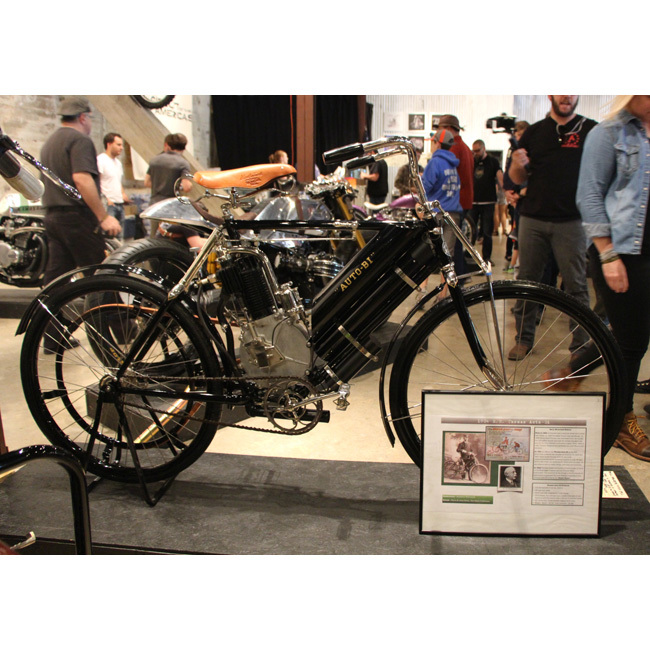
    In 1898, Edwin Ross “E.R.” Thomas began designing his two-wheeled, internal-combustion-powered bicycle, the “Auto-Bi.” What inspired his motorized bicycle/motorcycle was the advent of the safety bicycle (a bicycle with both wheels being the same size) in 1896 and his experience manufacturing the De Dion-Bouton tricycles since 1898. In 1900, his company, the Thomas Motor Company out of Buffalo, New York, produced the first Auto-Bi. In 1901, the first two models for the public were available for sale. His Auto-Bicycle is referred to by some as the “first production powered two-wheeled motorcycle”.

    Pictures from the Handbuilt Motorcycle Show

    The pictured Thomas Auto-Bi is a 1904 model. This motorized bicycle/motorcycle had a 4-stroke, 442 cubic inch engine that produced 2.5 horsepower, giving the Auto-Bicycle a 35-mph top speed. A 1905 model that was similar to the pictured Auto-Bi broke the transcontinental record by traveling across the US in 48 days. In 1912, there was insufficient demand for motorcycles, and the company ceased operations. E.R. Thomas moved on to building larger engines in an attempt to build an automobile company. Please let us know what you think of this article by posting this blog’s URL on your Facebook page with your comment. Finally, check out our Major Motorcycle Rallies and Motorcycle Events Calendar.
    Go to Our Blog Home Page
     
  • Motorcycle Chariot Racing

    Motorcycle Chariot Racing

    Have you ever come across vintage photos or footage of motorcycle chariot racing? It looks absolutely wild — and honestly, like a whole lot of fun.

    Unfortunately, there isn’t much detailed information about the history of motorcycle chariot racing. Still, here’s a brief look at the origins of this outrageous style of competition.

    The inspiration for this unique form of racing is often traced back to the 1925 film Ben-Hur: A Tale of the Christ. The dramatic chariot scenes captured imaginations, and before long, enthusiasts began recreating the spectacle with motorcycles. The earliest motorcycle chariots and organized races appear to have started in Australia, with the United States and parts of Europe soon following suit.

    So, what led to the downfall of motorcycle chariot racing? A major factor was the Great Depression. During that time, many people were simply trying to make ends meet. Few could justify the cost of building and maintaining a chariot pulled by two motorcycles — especially when crashes and mechanical damage were almost guaranteed.

    Then came World War II, which delivered the final blow. Wartime rationing severely limited access to metals and other essential materials.

    As a result, many motorcycle manufacturers struggled or shut down entirely, particularly those that did not secure government contracts and therefore lacked access to the resources needed to survive.

    Please let us know what you think of this article by pasting this post’s URL on your Facebook page with your comment. Finally, you might want to check out our Major Motorcycle Rallies and Motorcycle Events Calendar.

    Go to Our Blog Home Page


  • What Was the First Motorcycle Made?

    What Was the First Motorcycle Made?

    What was the very first motorcycle ever built? It’s a question that comes up often in the motorcycle world — and depending on who you ask, the answer can be very different.

    A big part of the disagreement comes down to definition. What exactly qualifies as a motorcycle?
    • Most people agree it must have some propulsion system — but what kind? Does it have to be powered by an internal combustion engine, or do steam engines and electric motors count?
    • Must it have only two wheels?
    • If it has small outrigger wheels that don’t touch the ground while riding, does this disqualify it?
    • And are we talking about the first motorcycle in the world, or just the first built in the United States?

    Fifteen or more years ago, the debate centered largely on engine type. Many enthusiasts insisted a “real” motorcycle had to use an internal combustion engine. Others were satisfied with steam power.

    Today, with the rise of electric motorcycles — regardless of where you stand on them — the conversation has evolved yet again, reshaping how some people view the earliest machines.

    Three of the Most Recognized “First” Motorcycles


    Pierre Michaux Velocipede
    In the 1860s, Pierre Michaux built pedal bicycles known as velocipedes in France. In 1867, his son Ernest mounted a small steam engine onto one of these machines. For some historians, this antique steam-powered velocipede qualifies as the first motorcycle.

    Michaux-Perreaux Steam Velocipede

    Vintage Picture of a Peugeot Motorcycle
     
    Sylvester Roper Steam Velocipede
    In 1868, Sylvester Roper of Massachusetts designed a steam-powered velocipede featuring a twin-cylinder engine. He continued developing and demonstrating his machines until 1896, when he tragically died while riding one. Many consider Roper’s creation the first motorcycle built in the United States.

    Aged Picture of Sylvester Roper with His Roper Motorcycle

    Aged Picture of Sylvester Roper with His Roper Motorcycle
     
    Daimler Reitwagen
    Developed in 1885 in Germany by Gottlieb Daimler and Wilhelm Maybach, the Reitwagen used an internal combustion engine — a key point for those who insist that “true” motorcycles must run on gasoline.

    The machine had two large primary wheels and two small outrigger wheels. Because of this, some argue it was technically a four-wheeled vehicle. However, since it could operate without the outriggers, many historians recognize it as a strong contender for the first true motorcycle.

    Vintage Picture of a Daimler Reitwagen
    Vintage Picture of a Daimler Reitwagen
     

    Other Important Early Motorcycles

    Below are some other notable motorcycles.

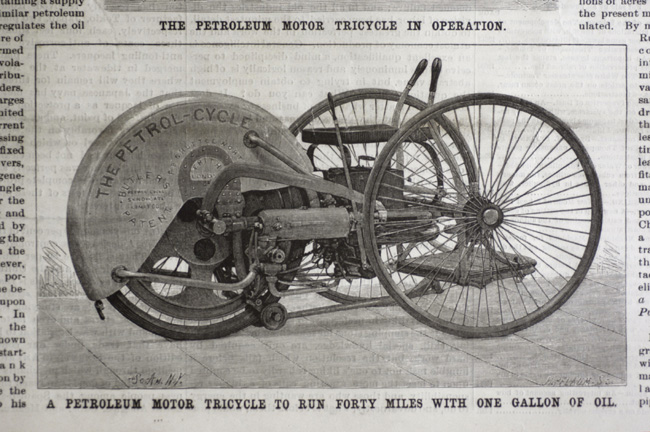
    Butler Petrol Cycle
    Introduced in England in 1884 by Edward Butler, the Butler Petrol Cycle had three wheels — making it technically a tricycle rather than a motorcycle. Still, it was notable for its petroleum-powered engine and innovative design, setting it apart from traditional four-wheeled vehicles of the time.

    Butler Petrol Cycle Motorcycle
    Newspaper Image of a Butler Petrol Cycle Motorcycle
     
    Hildebrand & Wolfmüller
    Built in Germany in 1894, this machine is significant because it was the first production vehicle officially called a “motorcycle.” It had two wheels and an internal combustion engine — features most people associate with modern motorcycles.

    The design differed from today’s bikes: the engine placement was unconventional, the frame lacked a backbone, and it resembled a 1970s moped. Unlike the Michaux and Roper machines, it also had no pedals.

    1894 Hildebrand Wolfmuller Motorcycle
    Hildebrand Wolfmuller Motorcycle on Display
     
    Orient-Aster Motorcycles
    In 1898, Charles Metz began producing Orient-Aster motorcycles in Massachusetts. Though the company eventually went out of business, these are widely recognized as the first production motorcycles made in the United States.

    Orient Aster Motorcycle
    Rebuilt Orient Aster Motorcycle
     
    Peugeot Motorcycles
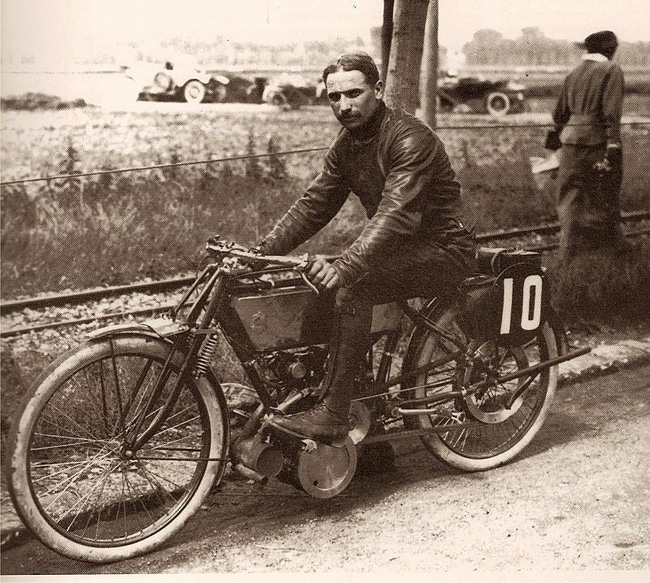
    In 1898, Peugeot also produced its first motorcycle. While the company now focuses primarily on scooters, some historians consider Peugeot the oldest surviving motorcycle manufacturer in the world.

    Vintage Picture of a Peugeot Motorcycle
    Vintage Picture of a Peugeot Motorcycle
     
    With all of the above being noted, the “first motorcycle” depends on how you define a motorcycle. Some people and historians prioritize gas engines, steam-powered engines, models that went into production, or the geographic location where each motorcycle was made. Each of these machines has a legitimate claim. The answer to the question of who made the first motorcycle isn’t easy — but that is one reason why motorcycle history is interesting.

    Please let us know what you think of this article by pasting this post’s URL on your Facebook page with your comment. Finally, you might want to check out our Major Motorcycle Rallies and Motorcycle Events Calendar.

    Go to Our Blog Home Page