Tag: Interesting Vehicles

  • Motorcycle Chariot Racing

    Motorcycle Chariot Racing

    Have you ever come across vintage photos or footage of motorcycle chariot racing? It looks absolutely wild — and honestly, like a whole lot of fun.

    Unfortunately, there isn’t much detailed information about the history of motorcycle chariot racing. Still, here’s a brief look at the origins of this outrageous style of competition.

    The inspiration for this unique form of racing is often traced back to the 1925 film Ben-Hur: A Tale of the Christ. The dramatic chariot scenes captured imaginations, and before long, enthusiasts began recreating the spectacle with motorcycles. The earliest motorcycle chariots and organized races appear to have started in Australia, with the United States and parts of Europe soon following suit.

    So, what led to the downfall of motorcycle chariot racing? A major factor was the Great Depression. During that time, many people were simply trying to make ends meet. Few could justify the cost of building and maintaining a chariot pulled by two motorcycles — especially when crashes and mechanical damage were almost guaranteed.

    Then came World War II, which delivered the final blow. Wartime rationing severely limited access to metals and other essential materials.

    As a result, many motorcycle manufacturers struggled or shut down entirely, particularly those that did not secure government contracts and therefore lacked access to the resources needed to survive.

    Please let us know what you think of this article by pasting this post’s URL on your Facebook page with your comment. Finally, you might want to check out our Major Motorcycle Rallies and Motorcycle Events Calendar.
    Go to Our Blog Home Page

  • Dog-Powered Cynosphere Tricycle

    Dog-Powered Cynosphere Tricycle

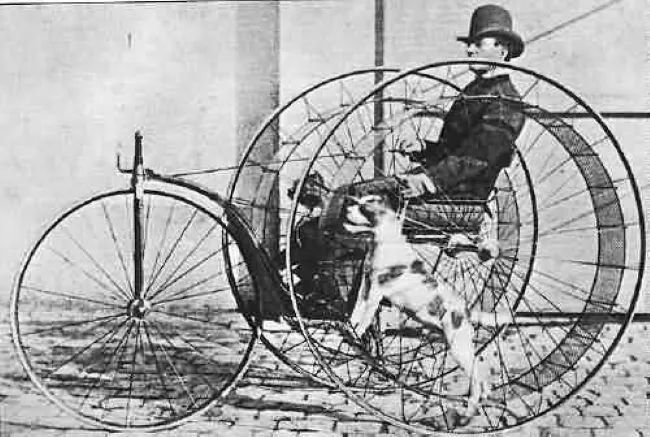
    In 1875, a French engineer designed a dog-powered tricycle. And it was called a Cynosphere. Also, it was in the September 1933 issue of Popular Science Magazine.

    Next, in the front, was a small wheel used to steer the vehicle. Then, in the back, were two larger wheels. These back wheels were fitted with cages, so when the dog moved forward, the tricycle moved forward too.

    The dog-powered tricycle had a high speed. And the rider could go faster by dangling food in front of the dog.

    Eventually, the Society for the Protection of Animals succeeded in banning these vehicles as a form of animal cruelty.

    Aged picture of a Dog Powered Trike Cynosphere

    Please let us know what you think of this article by pasting this post’s URL on your Facebook page with your comment. Finally, you might want to check out our Major Motorcycle Rallies and Motorcycle Events Calendar.

    Go to Our Blog Home Page

  • The Vespa 150 TAP Scooter with a Cannon

    The Vespa 150 TAP Scooter with a Cannon

    In 1949, the Italian Vespa Company unveiled prototypes of a scooter with a bazooka cannon mounted on it. In 1952, the Vespa 150 TAP (Troupes Aéro Portées) scooters were modified for use by paratroopers. The “150” part of the model name was used because the Vespas used a 150cc engine. With this upgraded engine and lowered gearing, the Vespa’s could go 40mph.

    The Vespas were also modified by the French company, Ateliers de Construction de Motocycles et Automobiles (ACMA). This was the assembly plant for Vespas in France at the time.


    Some of the modifications made were a reinforced frame and a three-inch M20 75mm recoilless rifle mounted to the Vespa. The gun, or at this size more of a cannon or a bazooka, used a High-Explosive Anti-Tank (HEAT) warhead. The bazooka Vespas were cheap, being sold at only $500.

    The TAP Vespas were dropped with two-person parachute teams. To avoid damage to the scooters when dropped from planes, they were protected by hay bales. On one Vespa, there would be the gun; on another, a tripod. Although the preferred way to shoot the cannon was on a tripod, it could be fired directly from a moving Vespa in an emergency.

    The M20 was initially designed as an armor-piercing, anti-tank weapon using the HEAT warhead. Manufacturers said the M20s could penetrate 100mm of armor and had a range of 7,000 yds. Although this didn’t prove to be the case, it could fortify positions in war.

    In 1959, because there were many new vehicles, weapons, and ways to quickly and easily get things into battle areas, production of the Vespa 150 TAP scooter ceased.

    Please let us know what you think of this article by posting this blog’s URL on your Facebook page with your comment. Finally, check out our Major Motorcycle Rallies and Motorcycle Events Calendar.

    Go to Our Blog Home Page

  • Roaddog – World’s Largest Motorcycle

    Roaddog – World’s Largest Motorcycle

    You’ve seen this black and white picture of a gigantic motorcycle with a guy on it, but what’s the story?

    The bike is the Gelbke Motorcycle Company’s Roaddog, and it is the World’s largest motorcycle. I say this in the present tense because the bike is still around and is now displayed at the National Motorcycle Museum.

    The rider is William “Wild Bill” Gelbke, and he built the first Roaddog in 1962. This 17-foot-long, 3,280-pound motorcycle monstrosity has a 4-cylinder, 152 cubic-inch Chevy Nova engine, an automatic transmission, two forward gears, and even a reverse. It has been said that it was reliable enough that Gelbke put 20K miles on it in the first year.

    In 1965 Wild Bill built the Roadog II (an improved version of his first giant creation) and later he also built what he hoped were going to be productions motorcycles called the Gelbke Auto-Four. Only a handful of the Auto-Fours were built and although they were a smaller motorcycle by comparison to the Roaddogs, they were a lot bigger when compared to even the largest motorcycles made by other manufacturers.

    One of the infamous stories was when Will Bill, who was living in Chicago at the time, decided he wanted to enjoy the good steaks and beer in Texas, so he hopped on the Road Dog, rode to Texas, enjoyed his steak and beer, and then rode back to Chicago.

    So what happened to Wild Bill? He died in 1978 in a shootout with the police. He may have passed, but this gigantic motorcycle and the stories about Wild Bill still survive today.

    Please let us know what you think of this article by posting this blog’s URL on your Facebook page with your comment. Finally, check out our Major Motorcycle Rallies and Motorcycle Events Calendar.

    Go to Our Blog Home Page


  • Vintage Lehaitre Tracked Motorcycle

    Vintage Lehaitre Tracked Motorcycle

    First, during wars, there are always many innovations across all fields. One of these inventions was the Lehaitre tracked motorcycle in 1939. The design and manufacturing were done by J. Lehaitre in Paris. Next, he called the vehicle a “tractor-cycle.”

    Also, his main inspiration for building the tracked motorcycles was to help troops navigate rough terrain. And one unique thing that the tractor-cycle could do that most vehicles couldn’t was to ride through bomb craters.


     Next, Lehaitre made the motorcycle by replacing the wheels with tractor tread. Also, the tractor-tread bike reached a top speed of 25 mph. And steering is controlled by the handlebars, moving the delivery belt sideways.

    Lehaitre planned to mount a machine gun on the tractor motorcycle if it were to deploy to a warzone. Although Lehaitre’s invention did not see any battles, it is a cool invention in the motorcycle world.

    Please let us know what you think of this article by pasting this blog post’s URL on your Facebook page with your comment. Finally, check out our Major Motorcycle Rallies and Motorcycle Events Calendar.

    Go to Our Blog Home Page